At the KAHN CENTER, we focus on research and education geared to prevent heart disease and the potential fatal consequences of heart attacks, strokes, heart failure and other syndromes. Dietary patterns play a major role in health and disease and contribute to many heart deaths annually.
A new study provides further data on the "Big 3" dietary patterns associated with up to 5.9 millions deaths a year from heart disease alone.
STUDY
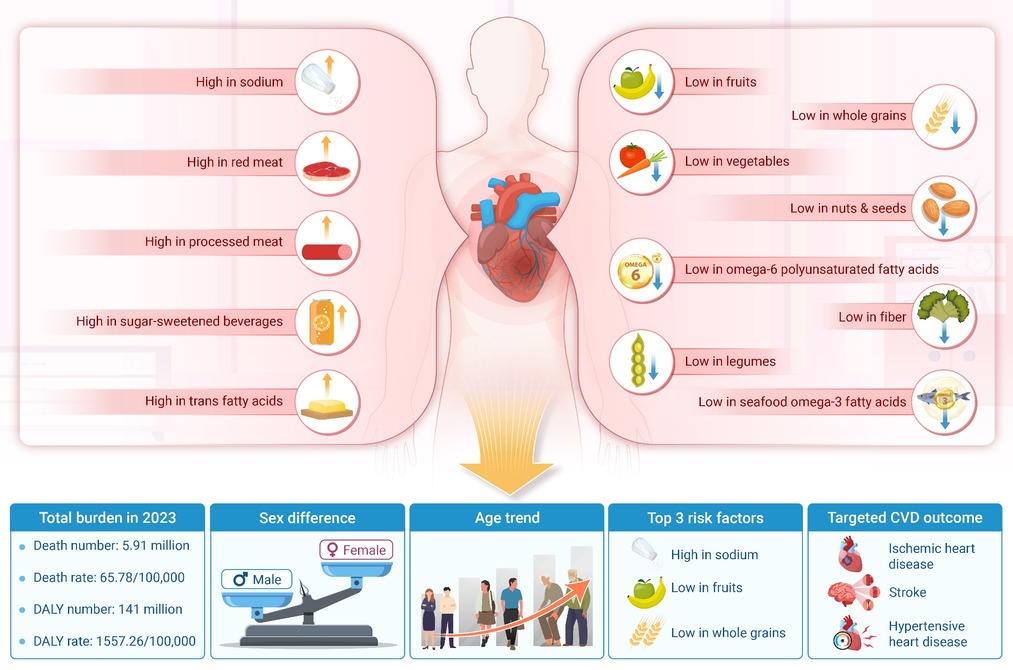
The Global Burden of Disease (GBD) study quantified global, regional, and national CVDs deaths and disability-adjusted life years (DALYs) attributable to 13 dietary risk factors between 1990 and 2023, using 2023 Global Burden of Disease data covering 204 countries and territories.
In 2023, dietary risks globally caused 5.91 million CVD deaths and 141 million (95% disability-adjusted life years (DALYs).
Considerable geographic heterogeneity was observed. China had the largest CVD deaths (1.36 million).
Globally, high sodium intake was the leading risk for CVD mortality and DALYs, followed by diet low in fruits and whole grains, particularly for ischemic heart disease and stroke.
Males consistently experienced higher diet-attributable CVD burden than females.
The global burden of diet-related CVDs remains substantial and unevenly distributed, requiring targeted, context-specific dietary interventions, particularly sodium reduction and increased fruits and whole grain intake.
SUMMARY
In 2023, dietary risks caused 5.91 million global CVD deaths and 141.12 million DALYs.
Considerable geographic heterogeneity for the diet-attributable CVD burden was observed.
High sodium and low fruits and whole grains intake were the top 3 risks for CVD burden.
Diet-attributable CVD mainly focused on ischemic heart disease and stroke.
Males consistently experienced higher diet-attributable CVD burden than females.